What is the Operating Floor in compliance training management?
In our earlier article, The 18-to-80 workforce: how to design compliance training that works, we introduced two principles: the Awareness Floor and the Design Floor. The first defines what employees need to recognise, understand or do. The second establishes whether the intervention gives employees a fair opportunity to develop that capability.
But even when both are properly addressed, an organisation can still have a serious weakness.
It may have excellent content, accurately translated into practical awareness and thoughtfully designed for its workforce, without having a dependable way to get that intervention to everyone who needs it.
This is why we introduce a third principle: the Operating Floor.
The Operating Floor is the minimum operational capability an organisation needs to deliver employee compliance awareness reliably. It includes identifying the correct employees, determining when interventions are required, managing delivery and follow-up, maintaining accurate records and ensuring that responsibilities are clear.
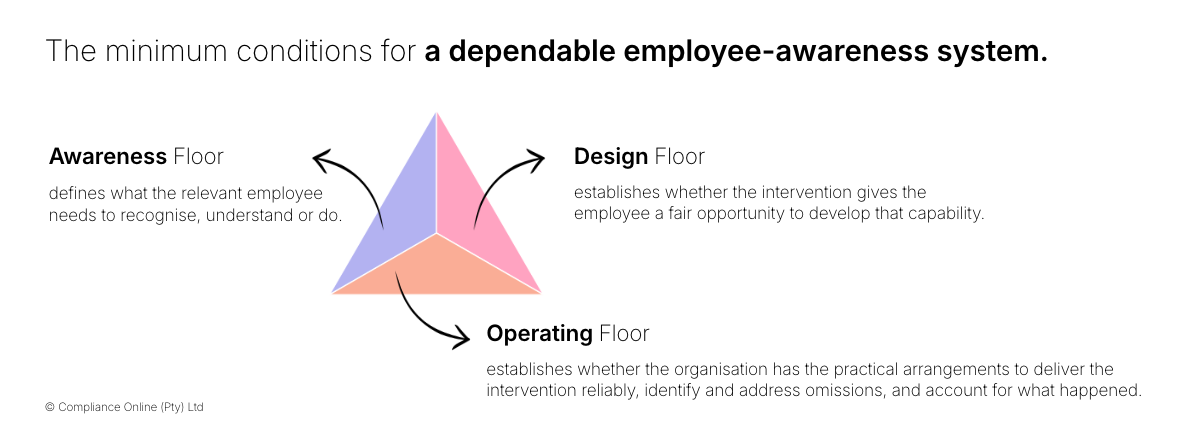
The three floors are interconnected. A well-designed intervention is of little use if employees never receive it. Equally, reliable delivery cannot compensate for training that fails to address the awareness employees actually need.
An organisation must therefore consider all three and ensure that the necessary work is properly resourced, whether it manages that work internally or appoints a provider to perform agreed parts of it.
What does the Operating Floor require?
Consider an organisation with 5,000 employees across several business units. It runs an annual compliance-awareness programme covering matters such as competition law, anti-bribery and corruption, privacy and workplace conduct.
Some employees complete courses through an LMS. Others work on sites where individual computer access is limited. New employees join throughout the year, existing employees move between departments, and different groups have different awareness requirements.
The organisation can purchase or develop excellent content for every topic. The difficult part, however, is maintaining a reliable process across all those moving parts.
There are six practical responsibilities that need to be addressed.
- Establish who needs what.
Every intervention needs a defined population: all employees, a division, a risk-exposed role or a group subject to a specific policy. That population keeps changing as people join, leave, change roles or arrive through reorganisations. Someone must track those changes and make sure they reach whoever runs the programme. - Determine when the intervention is required
Some needs belong at induction. Others call for periodic refreshers or a trigger such as a policy change or new responsibility. Whatever the approach, there must be a dependable way to know when training is due. A highly personalised schedule is only as reliable as the role data behind it, so a simpler, well-managed periodic programme is sometimes the more robust option. - Make delivery work for the workforce
E-learning may suit office-based employees, while a facilitated session may be more dependable for frontline or site-based teams. Access, language, scheduling and technical support all matter. The right method gives employees a reasonable opportunity to participate and can be run consistently. - Identify and follow up on omissions
This is where many programmes become operationally demanding. Someone must track who has been assigned, who has completed and who is outstanding, then act. That might mean a reminder, help with access, rescheduling or involving a manager. If an employee can’t access the course, another automated reminder won’t fix it. The process must resolve failures, not merely record them. - Maintain accurate evidence
Organisations need to be able to reconstruct what happened: who was included, which version applied, when it occurred, whether the employee completed it, how they performed in any assessment and what follow-up took place. A digital completion record, a signed attendance register and a facilitator’s confirmation are not identical evidence. Each is useful, provided the organisation understands what it establishes. - Make responsibility explicit
Someone must own the operational work: maintaining the population, assigning training, managing exceptions, preparing reports and investigating missing records. These tasks are often spread across HR, Compliance, learning administrators, line managers, IT and external providers. That can work, but every handover creates a dependency that must be managed rather than assumed to work.
When training is free, who carries the operating work?
Some regulatory technology and compliance service providers include scheduled training sessions in a subscription at no extra cost. That can be genuinely valuable, because it gives organisations specialist knowledge without the cost of building their own content.
But the provider usually only delivers the session, records attendance and issues certificates. The organisation is still responsible for deciding who needs the training, making sure they attend and following up with those who don’t.
Imagine an accountable institution with 300 employees who need FIC Act awareness training. Forty attend a webinar. The provider has done its part for those 40. The organisation still has to account for the other 260.
Training availability is not training coverage. Even when the content is included, someone still has to identify employees, arrange and track attendance, collect certificates, resolve exceptions and keep records. Self-registration can work well, but only when someone has been assigned and given the resources to run it.
Before relying on any external training arrangement, a risk owner should know exactly what the provider covers (content, access, delivery, tracking or follow-up) and what is left for the organisation to do.
Who should own the Operating Floor?
An important distinction is needed here, because the organisation remains responsible for its applicable compliance obligations, even when it obtains assistance from an external provider. The Financial Intelligence Centre’s reference guide for accountable institutions confirms this principle in the context of the FIC Act.
But organisational accountability does not mean every operational task must be performed internally. For example, an organisation may choose to run its own awareness programme using existing HR systems, an LMS, internal administrators and external content. Another may choose to outsource agreed aspects of delivery, enrolment management, learner support, tracking and reporting. Both can be sensible arrangements.
The key is to understand what each arrangement requires and to resource it accordingly.
An internal programme needs sufficient administrative capacity, dependable data, defined responsibilities and appropriate oversight.
A managed arrangement needs a clear scope of service, agreed information flows, defined exceptions and reporting arrangements. The provider must know what it is responsible for, and the client must retain the decisions and information that properly belong to it.
This is why the Operating Floor is a resourcing decision as much as a design decision.
Time, systems, employee information, administrative attention and management follow-through all have costs. If those inputs are not available, even a carefully planned awareness programme may struggle to operate.
An organisation should therefore ask not only what training it needs, but what it will take to maintain that training across its workforce.
AI makes the Operating Floor more important, not less
Technology is changing the economics of compliance awareness. AI can make regulatory content easier to draft, update, adapt and translate. It can assist with assessment development, administration and reporting. For compliance awareness, producing content is becoming less labour-intensive, but content production is only one part of the requirement.
An organisation may have access to more training material than ever before and still struggle to identify the right employees, maintain an effective delivery programme or account for outstanding requirements. AI may help with those tasks too, provided the underlying processes, data and responsibilities are sound. But technology cannot resolve an operational responsibility that the organisation has never properly defined.
The opportunity is to use technology to make the whole awareness system less burdensome and more reliable, rather than simply multiplying the amount of material produced.
Bringing the three floors together
The Standard Bank findings are a useful reminder that employee compliance training must work beyond the course itself, and highlight the importance of organisations being able to account for whether required training has occurred.
The Prudential Authority’s wider sector findings reinforce the need to consider training content, relevance, administration and evidence together.
And these questions apply well beyond financial crime compliance.
Whether the topic is competition law, anti-bribery and corruption, privacy, workplace harassment or conflicts of interest, an organisation must decide what awareness is appropriate and how it will be maintained.
That brings us back to the three floors.
The Awareness Floor defines the capability required. The Design Floor gives employees a fair opportunity to develop it. The Operating Floor ensures that the intervention reaches the right people and that the organisation can account for what happened.
The real test is not how much compliance training an organisation has available. It is whether the organisation has established an appropriate awareness requirement, given employees a fair opportunity to meet it, and built a dependable system for ensuring that the work happens.
That is what it means to operate a compliance-awareness system.
Compliance Online specialises in employee compliance awareness and evidence. Our work includes maintained regulatory content, client-specific adaptation, appropriate delivery routes, and agreed managed administration and reporting. We help organisations make employee awareness more reliable while keeping clear boundaries between awareness evidence and broader organisational compliance.